
COSI INTERVIEW SUCCESS FIELD GUIDE
Two decades of interview feedback, distilled into a guide.
We know preparing for an interview can be stressful. While your COSI recruiter will provide role-specific guidance, this essential advice - gathered from years of placing commercial talent in oncology - will help you prepare, perform, and land the role.
Before the call
The Preparation Imperative
Know the Science, Know the Market - your #1 priority
Before your interview, the single most critical step is to deeply research the product. Know the drug, its value to the market, and the company pipeline. This demonstrates initiative, intellectual curiosity, and genuine interest in the role and the sector.
Comprehensive Research: Beyond the Drug
Preparation extends beyond the product. To the best of your ability, research and be ready to discuss:
- The company's core values - interviews are often shaped around them.
- The competition and the wider market landscape.
- The main objectives of the role - be prepared to show you've thought through how you will successfully take them on.
- Optional, high-impact step: Consider drafting a brief 30/60/90 day plan.
Virtual & In-Person Logistics
Approach
- Quiet place, no distractions.
- Business professional attire - even virtual.
- Test webcam, sound, lighting, background.
- Full, undivided attention.
Avoid
- Driving during the interview.
- Distracting clutter in your backdrop.
- Dressing down because it's virtual.
- Untested tech - webcam, mic, or lighting.
In the room
Mastering Question Styles
Behavioral Questions Require Real Stories
While some interviews are conversational, most include formal, behavioral-based questions (e.g., "Tell me about a time when you…" or "What would you do if…").
- Always have short stories ready about accomplishments and challenges, but be prepared to dive into details immediately when asked.
- The best interviewees show, with specifics, how they've put strategies into practice.
The STAR Framework
Situation, Task, Action, Result.
The structure hiring managers listen for, even when they don't say so. Use it for every behavioral story:
- Situation: the context and stakes.
- Task: what you specifically owned.
- Action: the moves you made.
- Result: outcomes - quantified where possible.
The Power of Specificity
Be concise in your responses, but be prepared to provide specifics around:
- Your exact role in the situation or accomplishment.
- The challenges faced.
- The results and recognition.
- What you learned - and what you could have done better.
Handling Leadership Roles
If you are interviewing for a leadership position, be prepared to provide detailed examples - concise, but ready for depth - in areas such as:
- Building high-performing teams.
- Developing and implementing strategy.
- Leading through change, adversity, and ambiguity.
- Developing people, hiring, and firing.
Leadership Competencies
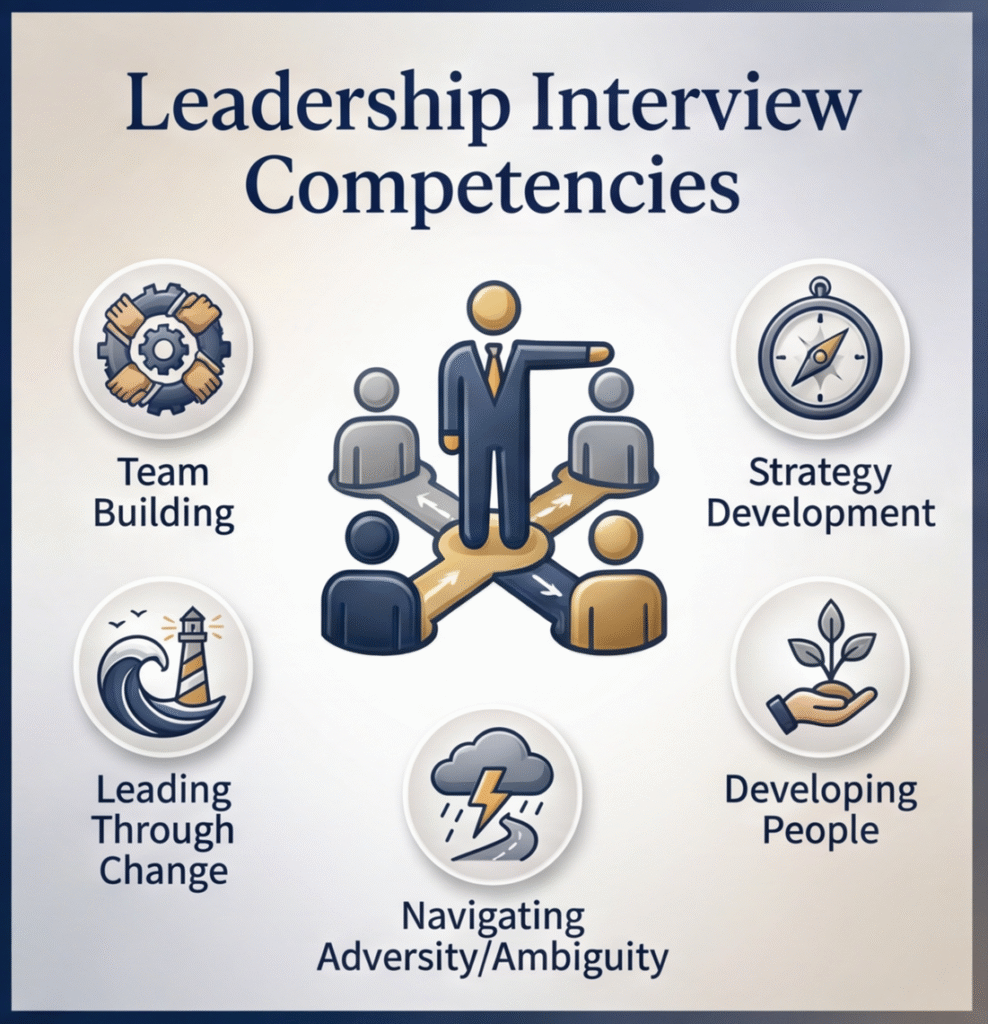
What hiring committees actually weigh.
For commercial leadership roles, expect probes across each of these dimensions. Have one specific, outcome-driven story per competency - and be ready to go deep on any of them.
When You Don't Know the Answer
If you don't have a relevant example off-hand, do not change the subject. Instead:
- Admit you need a moment and ask for a few seconds to think.
- If you are early in the interview, you might ask to address a different topic first and come back to the difficult question.
- Always ensure you do your best to get back to the original question.
A small unfair advantage
Talking through this with a recruiter helps.
Your COSI recruiter knows the panel, the hiring manager, and what they've asked past candidates. A short prep call is often the difference.
How you show up
The Art of Professionalism & Fit
The Two Core Questions
Hiring managers are fundamentally trying to answer two things:
- Will the candidate likely be successful in the role?
- Will we enjoy working with this candidate and will they contribute positively to our team and culture?
Balance and Tone
Interviewing is a balance.
- Communicate your value (based on past success) while maintaining humility and teamwork attributes.
- Don't feel pressure to fill silence. A short pause is often fine.
- Avoid profane language. It leaves a poor impression - especially for customer-facing roles.
Addressing Job Changes
If you have changed jobs more than once or twice, be ready to explain your reasons and why you are genuinely interested in this role. Be honest, but always frame the answer positively.
Frame It This Way
- "I was looking for a role that would let me…"
- "This opportunity aligns with where I want to grow."
- "I'm genuinely excited about your pipeline."
Avoid
- "I was bored" or "ready for a change."
- "I hated my boss."
- Anything overly negative about your previous company.
Treat Every Interviewer as the Decision Maker
Do not take any interviews for granted, even if you have a prior relationship with the hiring manager - there is no such thing as a 'shoe-in.' Treat every single person you interview with - from the assistant to the CEO - as if they are the sole decision maker. Companies that value culture and collaboration weigh the entire team's perspective.
The close
Evaluating & Closing the Opportunity
Expressing Genuine Interest
All candidates evaluate the opportunity, but be mindful of the "vibe" you project. If the interviewer gets the impression of, "Tell me why I should be interested in this job," they may assume you lack interest or haven't done your homework. Find the right balance between evaluating the opportunity and expressing sincere excitement for it.
Ask High-Value Questions
Have 2–3 thoughtful questions ready when given the opportunity. Do not make them about compensation, benefits, or anything self-focused that can be addressed later. Ideally, your question should lead back to the value you would bring to the organization in this role.
“The interview is a sales process. You are the product.
An analogy worth remembering
The Sales-Process Lens
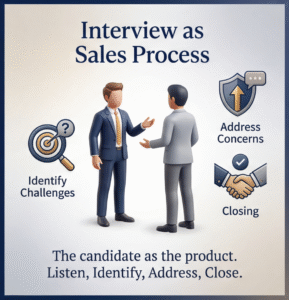
The interview as a sales call.
- Be a good listener - identify their challenges.
- Determine how your skills can solve those challenges.
- Anticipate concerns about your background - address them confidently and respectfully.
- Practice beforehand so nervousness doesn't hide the real you.
The Sales Close & Follow-Up
- Address concerns: ask if they have any remaining concerns about your ability to be successful in the role - giving you a chance to address them.
- Always 'close': affirm your interest at the end. State that you want the role and ask what the next steps are.
- Follow up: get business cards and send a thank-you note within 24 hours. Read your email at least twice to catch typos.
- Debrief: contact your COSI recruiter immediately after the interview so we can follow up with the hiring manager.
We wish you the best - and we're here when it's time to talk.
Whether you're building a commercial team or preparing for the interview that lands you on one, a 20-minute call is the fastest path forward.
For hiring managers
David Collins
President, COSI
Looking to upgrade your team? Schedule a call with David Collins to discuss your commercial oncology buildout - sales, MSL, marketing, market access, or leadership.
Schedule a call with DavidFor candidates
COSI Recruiter
20-minute prep call
Prefer to speak with a COSI recruiter? A short call with someone who knows your hiring manager can change the outcome. Pick a time that works.
Speak with a COSI recruiter